Before-and-after examples are illustrations. Use a revised description only when the facts match your work.
The short answer: AI changes development work, not the whole responsibility
AI tools can be used to draft code, tests and documentation. Check the result in your project: preparation time, review effort and issues found during verification. Generating a solution does not establish that it fits the system's constraints.
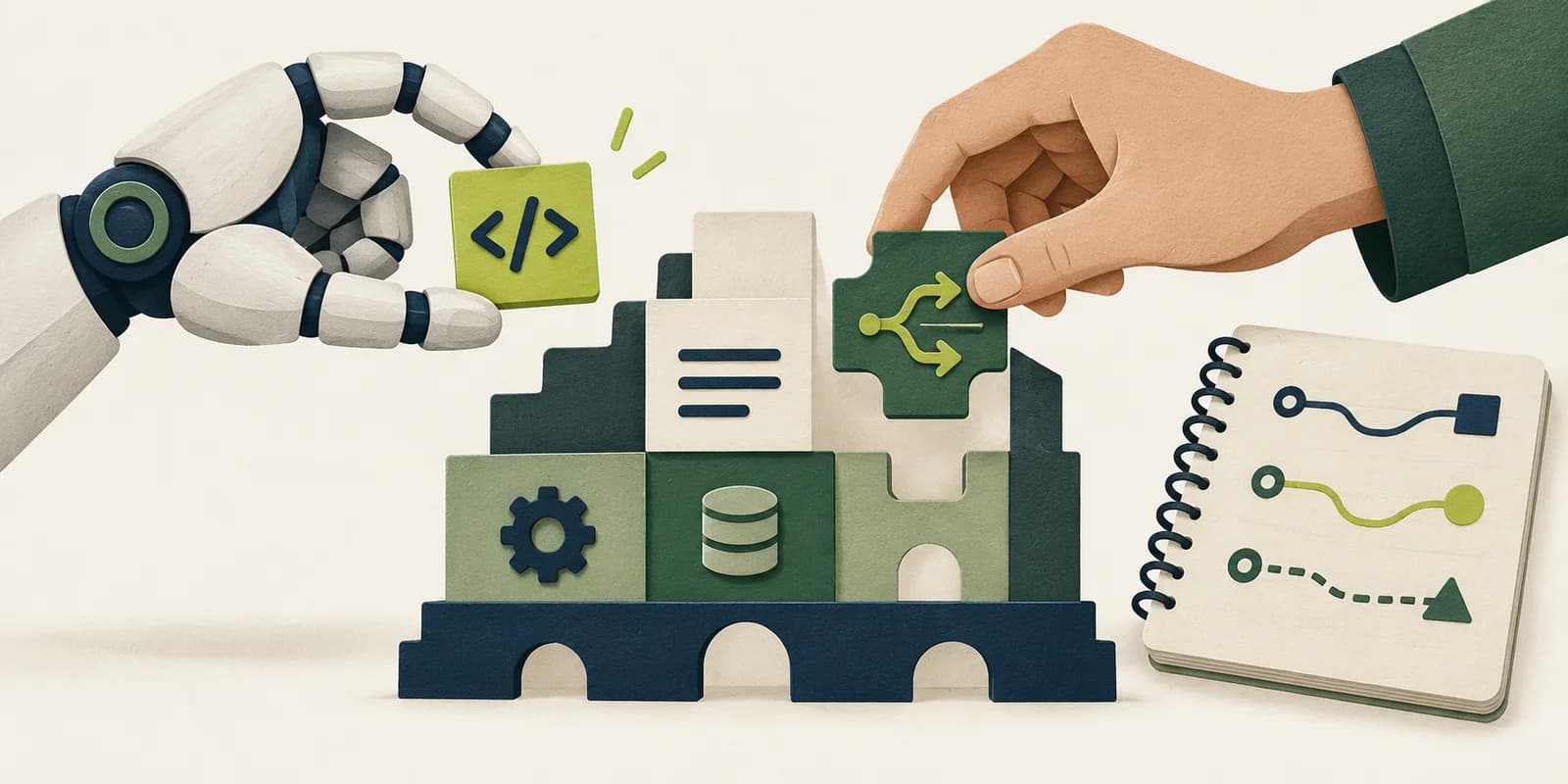
Separate executing a task from deciding what needs to be done. Defining a problem, agreeing scope and checking the outcome are concrete areas of responsibility you can develop alongside your use of tools.
Which tasks are easiest to automate
For an initial trial, choose a repeatable task with a clear input and verification method, such as a draft test, data transformation or working documentation. Treat faster execution as a hypothesis to test in your own process, rather than assuming every task will become faster.
Review one working week. Mark the tasks where both the input and expected output were obvious, then mark those that required finding a missing assumption, choosing a trade-off, aligning with other people or owning the result. The first group shows what to automate. The second shows where to deepen your professional advantage.
Do not compete on execution speed alone
Execution speed can be useful, but describe your value through quality and problem selection as well. Show how you identify constraints, choose an approach and check it after release.
Change the unit you use to describe your work. Show the problem, risk, decision and resulting change. Employers need someone who can decide which output makes sense, in which context and at what cost.
Move from task execution to problem ownership
AI can help produce an implementation, tests, documentation or infrastructure configuration. Generating that material does not determine whether the team is solving the right problem, whether its assumptions are true or whether the result works in the organisation's real environment.
Ownership means identifying ambiguity, gathering context, proposing a direction, negotiating trade-offs and checking the result after release. It is not reserved for managers or leads.
Implemented tasks using AI and participated in code review.
Identified the main source of release regressions, proposed an AI-assisted quality control and owned measurement of its effectiveness after rollout.
Build judgement that cannot be reduced to a prompt
Experienced value often appears before implementation: choosing the right problem, finding a false assumption, naming risk or rejecting a demo-friendly solution that would be expensive to maintain.
Judgement grows through domain knowledge, user understanding, architecture, data and the consequences of earlier decisions. Let AI generate possibilities, but be able to explain why one fits this system and organisation.
Become someone who makes other people more effective
Career resilience does not come only from individual expertise. It grows when your work helps a team make better decisions, detect risk earlier or use new tools safely. A standard, library, process, clear documentation or a quality control can create more leverage than one feature.
Look for leverage points: remove a recurring problem, make knowledge accessible, shorten a feedback loop or introduce a safeguard that lets other people act independently. This impact relies on trust and a real understanding of how the organisation works.
Use AI while retaining responsibility for quality
Avoiding AI is not a safety strategy. Learn where it accelerates work, where it requires verification and how it changes the risk profile. Combine AI speed with review, tests, observability and domain understanding.
Record mature examples: what became faster, how you verified the result, which data or systems were kept outside the tool and what protected the product from failure. Simply saying that you use an AI coding assistant will not remain distinctive; a responsible process can.
Self-audit: does your work look like ticket execution?
Review the last three months and answer plainly: who defined the problem, chose the approach, named the risk, aligned dependencies and checked the result after release? If your role always began with a ready-made ticket and ended at the pull request, treat that as useful development information rather than a verdict on your career.
Choose one area where you can broaden responsibility without changing your title. Ask about the business goal, propose a measurement, document a trade-off or return to the data after release. Even a small initiative can shift your role from following instructions to sharing responsibility for an outcome.
Show automation-resistant value in your CV
Your CV should show not only tools but why particular problems were entrusted to you. Expose decisions, domain knowledge, responsibility for results, work with risk and impact beyond your own task list. Do not describe yourself as ‘AI-proof’. Give the reader evidence from which they can form that view.
For each important role, ask three questions: what required context, which decision was genuinely mine and what became better for a user, product or team? The answers are useful both in the CV and in the interview.
Built features with React, TypeScript and AI tools.
Owned the redesign of a critical registration path: combined data analysis, AI-assisted prototyping and user tests, then monitored completion after release.
A practical 30-day plan
Week 1: divide the previous month's work into predictable execution and work requiring context, decisions or collaboration. Pick one repeatable task to accelerate deliberately with AI and define how you will verify its quality.
Week 2: own one small problem from diagnosis to outcome. Name the goal, constraints, risk and measure of success. The project need not be large; closing the responsibility loop is what matters.
Week 3: document one decision together with rejected options and consequences. Share useful knowledge through a short RFC, checklist, standard or documentation that makes other people more effective.
Week 4: rewrite two CV bullets. Replace duty language with truthful scope and outcomes, without inventing numbers or responsibility. Prepare one interview story about AI use: what it accelerated, how you verified the result and what remained a human responsibility.
Check your CV
- Do you know which parts of your work are predictable and easy to accelerate with AI?
- Can you name the problems you own, not only the tasks you complete?
- Do you show decisions that require domain context, judgement or risk management?
- Can you explain how you verify AI-assisted work?
- Do you return to outcomes after release instead of ending responsibility at the pull request?
- Does your work help other people make better decisions?
- Does your CV show outcomes and responsibility more clearly than tools?